Most companies run a penetration test the same way every year. A team probes the network, writes up what they find, and hands over a report. The security team sorts the issues by risk, opens a few tickets, patches what it can, and files the document away. On paper, the job looks done.
But real attackers do not work off your report. They work off your environment, your habits, and your blind spots. They look for the gap between what you think your defenses do and what those defenses actually do under pressure. That gap is where most breaches start, and a stack of patched findings rarely closes it.
Here is the shift worth making. A test should not only tell you what is broken. It should tell you if your business can spot an attack, slow it down, respond to it, and bring systems back online. This is what modern penetration testing should deliver: not a list of bugs, but a clear read on how your business holds up when someone tries to break it.
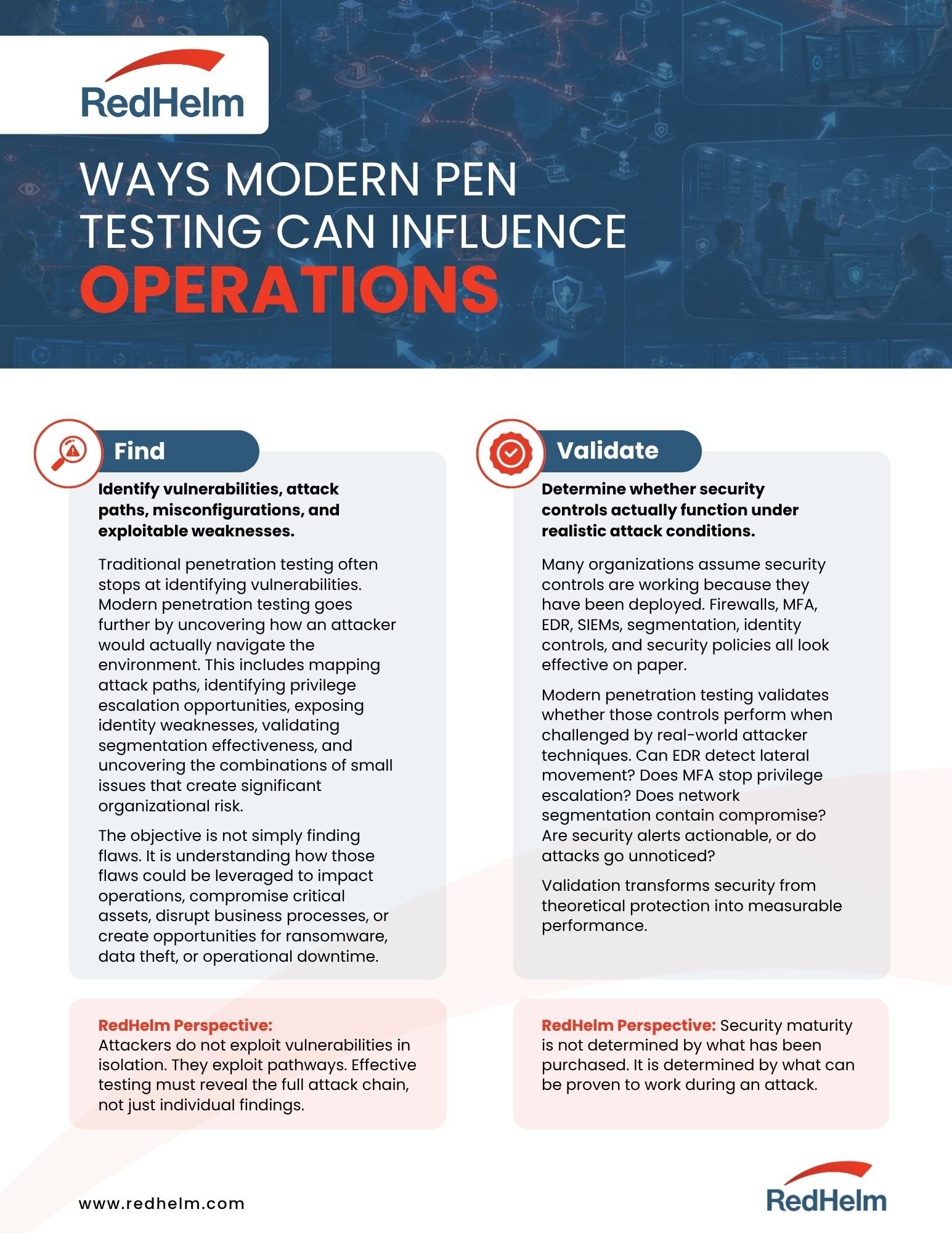
Click to Download the Full Guide
When a Test Becomes a Checkbox
Many organizations test once a year for reasons that have little to do with security. Auditors ask for proof. Cyber insurance carriers require it. Big customers want to see it before they sign. So the test happens, the report lands in a folder, and the program moves on.
There is nothing wrong with meeting those requirements. The problem starts when the requirement becomes the whole point. A clean checkbox can hide a messy reality. You can pass an audit and still have an attacker sitting in your network for months. Compliance proves you did the activity, but it does not prove your defenses work.
Treating cybersecurity validation as a paperwork task throws away the most useful part of modern penetration testing. The lessons that matter are the ones about how your team reacts, where your tools go quiet, and which calls you would need to make in the first hour of a real attack. Those lessons rarely fit in a risk score.

The Questions Modern Penetration Testing Should Answer
The old habit is to measure a test by counting bugs. A higher number feels like more value, and a lower number feels like a clean bill of health. Neither tells you much about your actual risk.
A stronger penetration testing strategy starts with operational questions instead of a vulnerability count. Ask these about your last test, or your next one:
- How did the attacker get in the first place?
- Which control was supposed to stop that but didn't?
- Once inside, how far could the attacker move?
- What data or systems could they reach?
- How long did it take anyone to notice?
- Could your team contain the activity before it spread?
- Would your recovery steps keep the business running?
These are not technical trivia. They are business questions. The answers tell you where your money and attention will do the most good, which is the real reason to test at all.

Offensive Testing as Business Intelligence
Read through that lens, offensive security testing turns into a source of decision-grade information. Each part of the test maps to a part of the business you already worry about.
Identity. Most attacks succeed because someone gets a valid login, not because they break through a wall. Verizon's 2025 Data Breach Investigations Report found that stolen credentials were the entry point for 22% of breaches, making them the most common starting point. A good test checks if a low-level account can climb to an admin account, if service accounts can be abused, and if too many people hold rights they never use. A cybersecurity risk assessment built around identity often reveals more than any scanner.
Segmentation. Once an attacker has a foothold, your network layout decides how bad things get. A red team assessment shows if someone can move sideways into a finance system, or if your boundaries actually slow them down.
Monitoring and detection. A test answers a quiet but huge question: would anyone notice? You learn which moves set off alerts, which slipped by unseen, and where your monitoring has holes.
Incident response. Plans look fine on paper. Pressure shows the truth. Testing reveals if your people know their roles, if they can talk to each other clearly, and where decisions stall while everyone waits for someone else to act.
Recovery. Bringing systems back is not only an IT task. It is a business choice about what comes first. A test shows if your recovery order matches what the business actually needs to keep running.

Why One Test a Year Falls Short
Attackers change their methods all the time. New tools, new tricks, and new weak spots show up every month. A single yearly test gives you one snapshot of a picture that keeps moving. By the time you finish patching last year's findings, the threat has already shifted.
Modern penetration testing works best as a steady loop, not a single event on the calendar. Mature programs build that loop with a few practices:
- Continuous validation. Test key controls on a regular schedule, not just before an audit.
- Adversary emulation. Copy the real steps known attacker groups use against companies like yours.
- Red team exercises. Run full, goal-based attacks that test people, process, and technology together.
- Security control validation. Confirm that the tools you bought do the job you bought them for.
Purple team cybersecurity ties all of this together. Instead of keeping the attacking side and the defending side apart, you put them in the same room. The offensive team runs a technique, the defensive team watches what their tools show, and both sides adjust on the spot. This kind of real-time teamwork closes gaps quicker than any report, and it steadily raises your security operations maturity.
This is the model RedHelm runs. Its Red Team and Blue Team work is built and run in-house as one coordinated function, so what the attacking side learns feeds the defending side right away. That same thinking shapes the way IT environments are managed day to day, so security sits inside normal operations rather than getting added later. RedHelm explains this in more depth in its look at why integrated security beats a layered stack.

Turning Findings Into Decisions
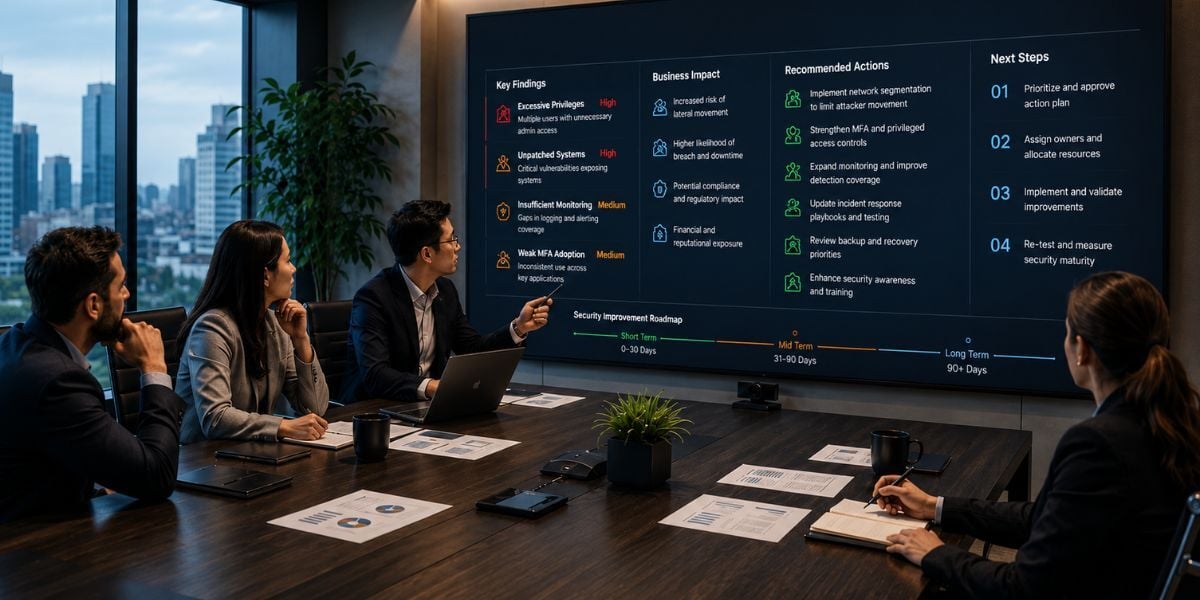
The report is not the prize. The decisions you make because of it are. The best engagements end with clear operational moves, such as:
- Adding network segmentation to box in any single breach.
- Tightening who holds privileged access and for how long.
- Strengthening multi-factor authentication where it is weak or missing.
- Widening monitoring coverage into the blind spots that the test exposed.
- Rewriting incident response steps that fell apart under pressure.
- Reordering recovery priorities so critical systems and cloud environments come back first.
- Improving training for the staff who keep getting targeted.
Speed is the thread running through all of these. IBM's 2025 Cost of a Data Breach Report found that the average breach took 241 days to identify and contain, the lowest figure in nine years, yet still more than eight months of exposure. Every decision above exists to shrink that window, because the longer an attacker stays hidden, the more a breach costs in money, downtime, and trust.
There is also the matter of who acts on these decisions when an incident is live. Strong operational resilience cybersecurity depends on clear ownership across detection, response, and recovery, not a relay race between separate vendors. RedHelm digs into that problem in its piece on who owns the outcome when security fails.
Treat Your Next Test as a Starting Line
Modern penetration testing should change something. If your last report led to a few patches and nothing else, you paid for a fraction of its value. The real payoff comes when results reshape how you handle identity, how you watch your network, how your team responds, and how quickly you can recover.
Look at your most recent engagement and ask one thing: what operational decision did it actually drive? If the honest answer is none, that is the place to start. Map the findings to business questions, bring your offensive and defensive thinking together, and treat each test as input for the next round of choices.
If you want a second set of eyes on how your current testing translates into real operational decisions, start a conversation with the RedHelm team.